
By Josh Cullinan, RAFFWU Director Strategic Litigation
On 22 July 2026 the Federal Court of Australia handed down its long awaited decision in the Domino’s Pizza Class Action. The class action was an innovative approach to securing worker entitlements through competition law – alleging misrepresentations by the franchisor to its franchisees caused actual loss to tens of thousands of workers when the franchisees paid the workers wrongly. The class action was the brainchild of RAFFWU and the lead applicant was RAFFWU member Riley Gall.
Launched in June 2019, heard in November 2022, the win on 22 July 2026 is difficult to overstate. To understand why, one must understand the back story. The multi-billion dollar franchisor instructed its franchisees to apply an old 2005 agreement they had struck with the Shop, Distributive and Allied Employees’ Association (‘SDA’ or ‘Shoppies’.) That deal was woeful from the start. It abolished weekend penalty rates, casual loadings, km based delivery allowances, 3 hour minimum shifts and more. It should never have been allowed to apply to anyone.
The 2005 Domino’s deal was the very essence of the compromise SDA offered employers in return for them helping SDA recruit workers and use payroll deduction as the means for those workers to pay their fees to SDA. That is, SDA sold out worker conditions so that bosses would help them recruit none-the-wiser workers to their ‘union’. These deals were struck across retail and fast food in Australia by SDA and stayed in place for decades until RAFFWU, launched in 2016, moved to get rid of them.
In fact, Domino’s Pizza had an unusual course. In 2012, members of the Anarcho-Syndicalist Federation had tried to terminate the 2005 deal but were thwarted by the employer, Fair Work Commission and SDA. The SDA then kept the deal in place, from time to time threatening to get rid of it to squeeze Domino’s Pizza to recruit a little harder for SDA. Then, in 2017, RAFFWU entered the space and terminated the 2005 agreement. SDA and Domino’s Pizza rushed to replace it but those efforts fell apart as 20,000 workers were lifted to the significantly higher Fast Food Industry Award conditions including penalty rates of up to 50% on weekends, 25% casual loadings, 3 hour minimum shifts and more.
Until now, SDA has been desperate to avoid scrutiny of just how much their agreements cost workers. The Domino’s Pizza Class Action exposed that in less than eighteen months Riley had been underpaid almost $12,000 – around a third of his income. The experience of tens of thousands of others won’t be much different. These aren’t musings of academics or partisans but the findings of the Federal Court of Australia.
The difference between Domino’s Pizza and others is that we were able to identify the franchisees had been misled about the instrument to apply. At McDonald’s, almost all franchisees had been captured by SDA agreements which sold out conditions. At KFC and Red Rooster, the SDA obtained special orders in 2013 inflicting its deals on new employers despite the workers never getting a say. At Hungry Jack’s, the vast majority of stores were controlled by the franchisor meaning the types of issues allowing action at Domino’s Pizza didn’t eventuate. However, all these fast food companies (and very many major retailers) had SDA agreements which caused similar colossal legalised wage theft.
Since RAFFWU’s inception, the agreements in retail and fast food have had to radically change to return minimum conditions or face likely defeat at the Fair Work Commission approval stage. However, that doesn’t mean conditions are meaningfully better than the relevant minimum Award. The massive cost increases imposed on the employers by having to increase to the minimum Award have seen miniscule premiums paid in new agreements and often in the face of conditions being cut. For example, at Hungry Jack’s and KFC, the employers have made part-time work less secure without any casual loading while paying only a few cents more per hour than the absolute minimum wage. Instead, the SDA has offered these new fixes in return for access to newly employed young workers, often children, to recruit in their first hours of work. Even the Fair Work Commission has now recognised this new tranche of SDA agreements do not provide any significant benefit to workers.
In this context, the Federal Court’s decision in Gall v Domino’s Pizza Enterprises Limited (No 4) [2026] FCA 967 delivers a dagger to the heart of the lie that SDA deals didn’t steal from workers.
In the days following the decision, one would think the ALP would pause to consider its dark industrial secret that it’s largest affiliate, the SDA, promotes child worker exploitation to pursue its conservative moral agenda. Now inescapably coded into a Federal Court judgement. To the contrary, the ALP has bowed to its masters in the SDA to pursue restrictions on RAFFWU in an effort to save the SDA carcass.
A common theme of SDA sycophants is their treatment of others as inferior, less than and to be exploited. For decades the oft young women working in retail and fast food were expendable for the SDA’s political agenda of anti-abortion and anti-queer policies. The SDA machine treated these young workers as fodder in its industrial scale wage theft apparatus. When this was exposed by the author and others in 2015, with RAFFWU launched in 2016, SDA turned its focus to those reliant on its power – union and ALP officials fattened on the largesse of a two party, union monopoly system. For ten years a cavalcade of labour movement apparatchiks have derided RAFFWU calling for ‘change from within the tent’ at SDA. In effect, every one of them is calling for the ongoing wage theft and exploitation of the next generation of workers for their own political gain.
However, times are changing. Workers are mobilising in retail and fast food. Employers are becoming wary of RAFFWU concerns the undue influence and unconscionable conduct occurring on their shopfloors by SDA Recruitment Agents may land employers liable for SDA conduct. Yet within the apparatchik tent time remains stuck in 1990.
Instead of ALP reconsidering its relationship with SDA, it dived straight in with motions and demands for fighting unions like RAFFWU to be stopped from further impacting the SDA business model. No less than the Federal Minister for Industrial Relations, a past SDA staffer, moved the motion claiming RAFFWU isn’t genuine and her past employer ought be protected. Victorian Labor’s new premier has taken it further moving laws which would close RAFFWU – a direct payoff to his SDA masters for allowing him to be premier.
Politicians Legislating To Protect Own Job
The truth is each SDA aligned politician, including them, hold their seats on a fabrication. ALP candidate preselection arises based on power within its ranks. That power, for affiliated unions, is based on membership numbers. The membership of SDA has rapidly and radically declined in the last ten years. While still claiming to represent over 190,000 members, the maths tells a different story. In 2015 the maths told a simple but Walkley Award winning story about SDA helping employers steal wages through industrial agreements. Simple maths on three fronts helps us tell the story of the true SDA membership.
SDA Own Finances
The first and most simple place to start is the SDA’s own financial reports. These are not all available because despite the rhetoric of SDA sycophants, some entities do not report all their income. This is explained further below.
However, we know Queensland, Victoria and New South Wales are reporting their income and they are the largest claimed branches of SDA. We can explore their membership income from their annual financial statements and map this against what their membership should be based on that income. This is aided by the known membership fee at SDA. Over the period 2012 to 2025 the fee at SDA increased between 37% and 48%. On average, we estimate it increased about 44%. This means we expect that the same membership in 2012 should now return 44% more income in 2025. While we understand there may be small fluctuations in the average member fee, by and large it should remain fairly static in an industry with relatively static casualisation, common part-time work at SDA sites and a fee structure based on hours worked (not age, casualisation or other dimensions.)
So, $16m in fee income in NSW in 2013 is claimed to be for 58,202 members. The same income was received in 2024. For the period 2014-2023 the fee increase was closer to 25% so we would expect the same membership to have paid 25% more, or a 25% reduction in membership to achieve the same income – some 44,000. Instead, SDA NSW reported 54,805 members.
Victoria has reported a 20% decline to around 40,000 members in 2024/25. In Queensland, the branch has reported a 31% decline between 2021 and 2025. SA/NT reports are opaque. There has been a substantial increase in unfinancial membership in that branch but the Fair Work Commission doesn’t require ‘financial membership’ to be reported so by simply keeping unfinancial members on the books for years – perhaps a child worker who quit days after learning they were tricked – the SDA inflates its ALP membership. A number of branches don’t appear to report to FWC the financial statement of an operating entity but rather merely reporting entities.
While the Queensland and Victoria branches of SDA do report a decline, they too seem to be hiding substantial unfinancial membership. A common theme appears to be a decline in actual membership of over 30% across recent years which probably has reduced the SDA from a peak of around 200,000 to something closer to 120,000 enrolled members. Such declines cannot be kept hidden forever. Eventually, competent regulators will dig deeper as they did at TWU and AWU where substantial, but not as massive, over reporting of membership was exposed.
ABS Data
The Australian Bureau of Statistics maintains a biennial report on trade union membership in Australia. That data descends to the sectoral level identifying changes in ‘retail union membership’ in August of each second year since 2014. It shows a massive ongoing decline of over 31% in the period 2018-2024.
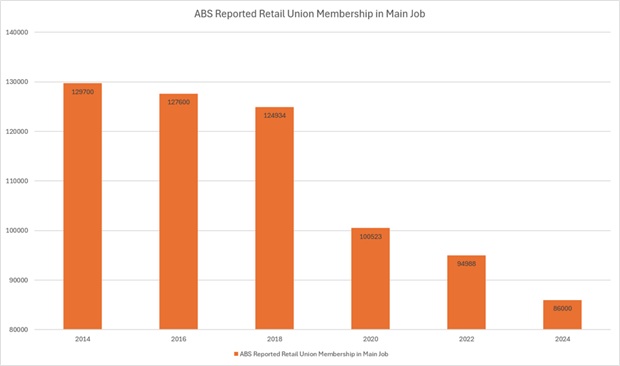
See ABS Catalogue 6335.0
Employer Statements
In addition to the SDA’s own financial statements and the ABS analysis, we have the statements of the employers themselves. These arise in a number of contexts. In 2015 the Queensland Electoral Commission required reports of payments to ALP affiliates and the SDA reported Queensland membership income from its main business partners. This showed over 90% of its income came from the Woolworths Group, Wesfarmers Group and Coles Group entities. The lions share from Woolworths (46%) and Coles group (27%). Wesfarmers entities like Kmart, Officeworks, Bunnings and Target made up about 15%. This supports the notion SDA is entirely reliant on the favour of a small cohort of employers to maintain its existence.
In ten years of organising workers in retail and fast food, we have seen this in the workplace in a number of ways. Outside of workplaces where the business helps SDA recruit, it has negligible presence.
The main statements we have from employers comes during contested enterprise agreement approval cases where the employers decry RAFFWU objection as inconsequential and note the presence of SDA in its stores. They have gone as far as to give this a numerical figure. We can then combine these reports and make reasonable assessments of total membership from this.
Woolworths Group reported in its Woolworths Supermarkets brand the SDA had about 50,000 members in 2024 (42% of about 120,000 employees.) In its Big W brand, it reported about 7,000 in 2023. At Coles Supermarkets, the business claimed there were in excess of 30,000 members of SDA in April 2024. We know SDA has negligible membership at McDonald’s and relatively small membership at Hungry Jack’s and Domino’s Pizza. It’s KFC membership fluctuates between states but is well below 10,000. SDA is desperate to strike a deal at McDonald’s to gain access to child workers (to deceive and force them to join its ranks.)
So by combining these modest known membership figures, adding a small number for the Wesfarmers entities, and small numbers for other employers, we arrive at around 120,000 members nationally. A remarkably similar number to the figure we expect from the SDA financial analysis above. It also shows an approximate 35%-40% decline over the last decade which is similar to the ABS reported decline. Such declines are existential for SDA and the politicians who rely on their favour. That is why they are desperate to stop RAFFWU and return SDA’s business model of unchecked worker exploitation.
Regulation Lie
Another oft repeated falsehood is that SDA as a registered organisation is subject to some outrageously greater scrutiny than RAFFWU. This is simply untrue. The obligations on each are different but this does not mean RAFFWU’s obligations are lesser than SDA. To the contrary, RAFFWU is subject to scrutiny of the Australian Securities and Investments Commission (‘ASIC’) and Consumer Affairs. RAFFWU committee members are required to meet the higher standards of directors under corporations law. A good example is RAFFWU, by its rules and incorporation legislation, must produce audited financial statements to its members and government regulators. Whereas only limited reporting entities must do this for SDA.
A case in point is the South Australian branch of the SDA from which the IR minister hailed. That branch claims to have 33,363 members but only income of $1.7m with six staff. Its own website claims to have 26 staff. The actual reporting entity is clearly not the operating entity and this affects a number of SDA branches. If the simplest of books don’t have to be presented to the regulator, what else is being kept secret?
Drawing a distinction between RAFFWU and SDA based on their regulation is a crude attempt to impugn RAFFWU’s impeccable administrative, financial and governance record. None of those who do it have lifted a finger to hold the big businesses and their SDA to account for the many billions stolen from workers through their legalised wage theft.
Context Belies Actions
So it is in this context of a radically diminishing SDA, continuing to allege far greater membership than is accurate to maintain political power, that its servants in the ALP are desperate to attack RAFFWU and return the SDA business model. This isn’t about organising and building union. SDA knows only one way to recruit. Making deals with the bosses which cut worker wages and allow its charlatan recruitment agents to trick or force children to join. The SDA sycophantic politicians are desperate to keep their jobs built on the exploitation of young, insecurely employed retail and fast food workers. It’s time they faced a reckoning.